

AliExpress has been officially banned in India since September 2020. The app remains blocked, and direct ordering to India is not possible through the platform. However, the website became partially accessible again in August 2025, though shopping functionality remains disabled.
This guide covers the current situation, workarounds that some buyers use, customs and tax implications, and alternatives for sourcing products from China.
Table of Contents
Is AliExpress banned in India
Yes. The Indian government banned AliExpress along with 117 other Chinese apps on September 2, 2020, under Section 69A of the Information Technology Act. The ban was part of broader restrictions following border tensions with China.
Current status (as of 2025):
| Component | Status |
|---|---|
| Website | Accessible (can browse products) |
| Mobile app | Blocked on Play Store and App Store |
| Shopping/checkout | Disabled (cannot complete purchases) |
| Shipping to India | Not available through official channels |
If you try to place an order with an Indian address, you will receive an error at checkout. Most products show “This item cannot ship to your selected country.”
Why AliExpress was banned
The official reasons cited by the government:
- National security concerns over data handling
- Privacy issues related to user data collection
- Sovereignty and integrity concerns
- Part of the “Atmanirbhar Bharat” initiative to promote local alternatives
The ban followed escalating tensions at the Ladakh border in 2020 and was part of a broader crackdown on Chinese technology services in India.
Can you still order from AliExpress to India
There is no official method to order from AliExpress directly to India. However, some buyers use workarounds:
| Method | How it works | Risks |
|---|---|---|
| VPN + contact seller directly | Browse via VPN, message seller, pay through PayPal, seller ships “unofficially” | No buyer protection, high scam risk, customs seizure possible |
| Freight forwarder | Order to a warehouse in Hong Kong/China, forwarding service ships to India | Additional fees, longer shipping, customs still applies |
| Alibaba (not banned) | Source similar products through Alibaba’s B2B platform | Higher MOQs, need to negotiate with suppliers |
| Alternative platforms | Use DHgate, Banggood, or other sites that ship to India | Different seller base, may have same products |
We do not recommend the VPN + direct seller method. Without AliExpress buyer protection, you have no recourse if the product never arrives or is not as described. PayPal disputes are possible but not guaranteed to succeed for international transactions.
The freight forwarder method (step-by-step)
A freight forwarder is a company that receives your package at a warehouse address (typically in Hong Kong, Singapore, or China) and then ships it to your address in India. This bypasses AliExpress’s shipping restrictions.
How it works:
- Sign up with a freight forwarding service (Buyandship, ShopandShip, or similar)
- Get your assigned warehouse address (usually Hong Kong or Singapore)
- Browse AliExpress using a VPN if needed
- Set your shipping address to the freight forwarder’s warehouse
- Place your order and pay normally
- Once the package arrives at the warehouse, the forwarder notifies you
- Pay the forwarding fee
- The forwarder ships to your Indian address
- Pay customs duty when the package arrives
Costs involved:
| Component | Typical cost |
|---|---|
| Product price | As listed on AliExpress |
| Shipping to warehouse | Often free or minimal |
| Forwarding fee | ₹500-1,500+ per kg depending on service |
| Customs duty | 20-40% of declared value (varies by product) |
| Handling fee | ₹100-500 (charged by courier) |
Important:
Customs duty still applies when the package enters India. The freight forwarder method does not avoid taxes, only the shipping restriction.
How customs duty is actually calculated (with examples)
This is where many buyers get surprised. Indian customs charges are not a single percentage but a layered calculation.
Components of import duty:
| Tax | What it is | Typical rate |
|---|---|---|
| BCD (Basic Customs Duty) | Primary import tax | 10-40% depending on product |
| SWS (Social Welfare Surcharge) | 10% of BCD | 1-4% of product value |
| IGST (Integrated GST) | Applied on (CIF + BCD + SWS) | 18% (most products) |
CIF = Cost + Insurance + Freight (total landed value)
Example calculation for electronics worth ₹5,000:
| Step | Calculation | Amount |
|---|---|---|
| CIF value | Product + shipping | ₹5,000 |
| BCD (20% for electronics) | ₹5,000 × 20% | ₹1,000 |
| SWS (10% of BCD) | ₹1,000 × 10% | ₹100 |
| Subtotal | ₹5,000 + ₹1,000 + ₹100 | ₹6,100 |
| IGST (18%) | ₹6,100 × 18% | ₹1,098 |
| Total duty | BCD + SWS + IGST | ₹2,198 |
| Total landed cost | CIF + Total duty | ₹7,198 |
This means a ₹5,000 product can cost ₹7,198 after customs, a 44% increase.
Products under ₹2,000: Often pass without customs charges, but this is not guaranteed. Customs officers can still assess duty on any package.
Products under ₹5,000: May qualify for simplified processing, but IGST still applies.
Gifts under ₹5,000: Exempt from BCD if clearly marked as a gift from an individual. However, IGST may still apply, and enforcement varies.
Alternatives to AliExpress in India
Since AliExpress is not accessible for direct purchases, these platforms offer similar products:
| Platform | Type | Ships to India | Best for |
|---|---|---|---|
| Alibaba | B2B wholesale | Yes | Bulk orders (10+ units), business sourcing |
| DHgate | B2C/B2B hybrid | Yes | Small quantities, similar to AliExpress |
| Banggood | B2C | Yes | Electronics, gadgets, hobby items |
| LightInTheBox | B2C | Yes | Fashion, wedding items, decor |
| Temu | B2C | Check availability | Low-cost consumer goods |
| IndiaMART | B2B | Domestic | Indian suppliers, local sourcing |
| 1688.com | B2B (Chinese domestic) | Via agent only | Lowest factory prices, requires sourcing agent |
Alibaba vs. AliExpress:
Alibaba is owned by the same parent company and is not banned in India. The key differences:
| Feature | AliExpress | Alibaba |
|---|---|---|
| Target buyer | Consumers | Businesses |
| Minimum order | 1 unit | Often 10-100+ units |
| Pricing | Retail | Wholesale (lower per unit) |
| Shipping | Included in listing | Negotiated separately |
| India access | Banned | Available |
For single items, DHgate or Banggood are closer alternatives to AliExpress. For bulk orders, Alibaba works well.
Using Alibaba to source products for India
Since Alibaba is accessible, here is how to use it:
Step 1: Search for products
- Go to alibaba.com and search for your product
- Filter by “Trade Assurance” for buyer protection
- Look for suppliers with “Verified” badges
Step 2: Check shipping terms
- Look for DDP (Delivered Duty Paid): Supplier handles customs and duties
- DAP (Delivered at Place): You pay customs on arrival
- Most India shipments are DAP
Step 3: Contact the supplier
- Message via the platform: “Can you ship to India? What is the minimum order quantity?”
- Ask for sample orders if testing a product
- Negotiate pricing for quantities above MOQ
Step 4: Payment
- Use Trade Assurance for protection
- Avoid direct bank transfers for first orders
- PayPal is accepted by some suppliers
Step 5: Track and receive
- Alibaba provides tracking through the platform
- Customs will notify you if duty is owed
- Pay duty at delivery (India Post) or before release (private courier)
Payment methods for Indian buyers
For platforms that do ship to India (Alibaba, DHgate, Banggood):
| Method | Works on | Notes |
|---|---|---|
| Visa/Mastercard | All platforms | Enable international transactions |
| Debit card | Most platforms | Must have international enabled |
| PayPal | Some suppliers | Strong buyer protection |
| UPI | Limited | Rare on Chinese platforms |
| Virtual cards | All platforms | HDFC, ICICI offer these; good for security |
Tip: Use a virtual card for international purchases. Most Indian banks (HDFC, ICICI, SBI) offer virtual cards through their apps. This limits exposure if the card details are compromised.
All major platforms use escrow payment systems, meaning the seller receives payment only after you confirm receipt.
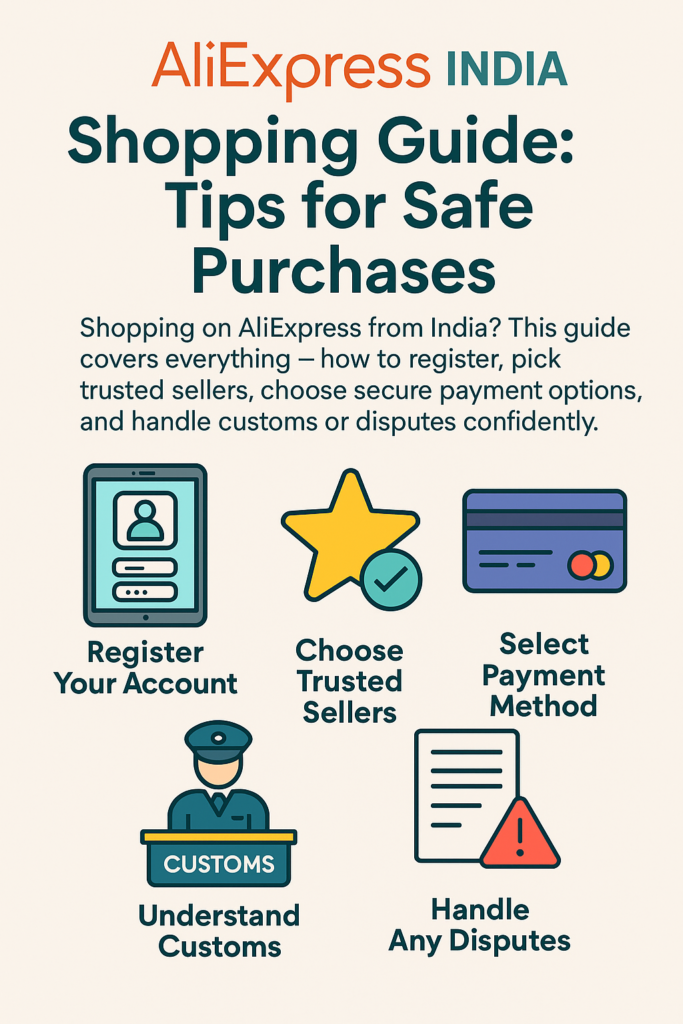
Shipping options and delivery times
For platforms shipping to India:
| Method | Time | Cost | Tracking |
|---|---|---|---|
| Standard shipping | 20-45 days | Often free | Limited or none |
| AliExpress Standard / Cainiao | 15-30 days | Low | Yes |
| Private couriers (DHL, FedEx, UPS) | 5-15 days | High (₹1,000-5,000+) | Full tracking |
Private couriers and customs: DHL, FedEx, and UPS handle customs clearance for you but will invoice you for duties before delivery. This is convenient but removes the chance of the package clearing without duty.
India Post: Slower but sometimes packages clear without customs assessment for low-value items. Not guaranteed.
What to do if your order has issues
If you order through Alibaba, DHgate, or another platform that ships to India:
If the order does not arrive:
- Check tracking on the platform and 17Track.net
- If past estimated delivery, contact the seller
- If no response within 48 hours, open a dispute
- Upload tracking screenshots as evidence
- Platform reviews and issues refund if approved
If the product is wrong or defective:
- Take photos/video before opening packaging
- Contact seller with evidence
- If no resolution, open dispute within protection period (usually 15-60 days)
- Request partial or full refund depending on issue
If held at customs:
- Courier will notify you with a duty amount
- Pay the duty to receive the package
- If duty seems too high, request a breakdown from customs
- You can dispute the valuation with supporting documents (invoice, payment proof)
Final thoughts
AliExpress direct shopping is not possible in India as of 2025. The website is accessible for browsing, but checkout and shipping to India remain blocked. Workarounds like freight forwarders exist but add cost and complexity.
For most buyers, alternatives like Alibaba (for bulk), DHgate (for small orders), or Banggood (for electronics) are more practical. All imports still face customs duties of 20-45% depending on the product category, so factor this into your total cost before ordering.
FAQ
1. Is AliExpress working in India in 2025?
The website is accessible for browsing, but you cannot place orders or receive shipments. The app remains banned. For purchasing, you need alternatives like Alibaba, DHgate, or freight forwarder services.
2. How much customs duty will I pay on imports from China?
Typically 20-45% of the product value, depending on the item. This includes Basic Customs Duty (10-40%), Social Welfare Surcharge (10% of BCD), and IGST (18%). Products under ₹2,000 sometimes clear without duty, but this is not guaranteed.
3. Can I use a VPN to order from AliExpress to India?
You can browse with a VPN, but AliExpress will still reject Indian addresses at checkout. Some buyers contact sellers directly and pay via PayPal, but this bypasses all buyer protection and carries significant scam risk.
4. What is the best AliExpress alternative for India?
For single items: DHgate, Banggood, or LightInTheBox. For bulk orders: Alibaba. For domestic sourcing: IndiaMART. For the lowest factory prices with a sourcing agent: 1688.com.
5. Will AliExpress be unbanned in India?
As of 2025, there is no official timeline for lifting the ban. The website became accessible in August 2025, but shopping functionality remains disabled. Government announcements have not indicated when or if full access will return.

Leave a Reply